


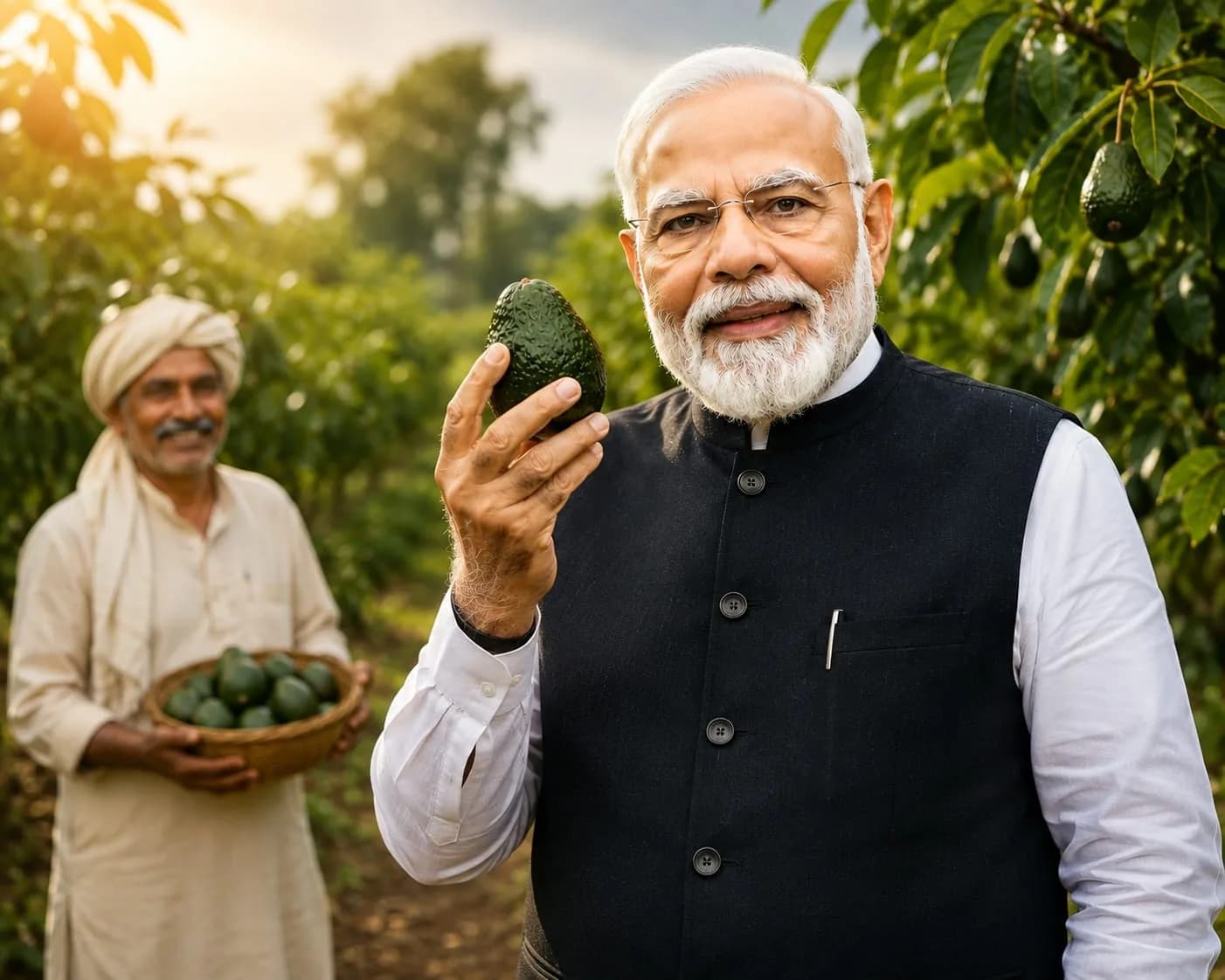
A fruit once considered too bland, too foreign and too expensive for Indian tastes is now showing up in an unlikely place a monthly radio address from the Prime Minister of India.
On August 30, during the 137th episode of Mann Ki Baat, Mr. Narendra Modi spent a few minutes talking about avocados. Not the avocado toast served in metro cafés, but the farmers behind it. "The avocado fruit is creating quite a buzz these days," he said, noting that a fruit almost nobody recognised a generation ago is now a regular fixture on Indian dining tables.
It would be easy to file this away as a passing mention in a programme known for spotlighting small, feel-good stories. But scratch beneath the anecdotes, and there's a genuine if still nascent agricultural shift underway, one that says as much about changing Indian appetites as it does about farming.
The Farmers Mr. Modi Named
Modi's examples were specific. He spoke of Varadaraj, a farmer from Kadapa in Andhra Pradesh, who had spent years growing tomatoes and bananas before spotting an avocado crop on a friend's farm. Curious, he taught himself the basics through YouTube videos. Varadaraj has since harvested close to four tonnes of avocados and sells them directly to local shops a shift Modi credited to "the new crop, scientific advice, and direct marketing."
Then there was Chandrashekharan, a farmer from Kodaikanal in Tamil Nadu, who put half a hectare under avocado. According to Modi, the crop is fetching him strong prices and has lifted his income.
The third example widened the lens to a whole region: Chikkamagaluru in Karnataka, better known as coffee country. Farmers there have started planting avocado trees between their coffee bushes, using the fruit as a companion crop that brings in extra income alongside coffee and black pepper without displacing the estate's main harvest.
Modi tied the three stories together with a line aimed squarely at urban listeners: city dwellers may associate avocado with toast at a trendy restaurant, but "our innovative farmers have discovered a new recipe for earning" from the same fruit.
Why Avocado Suddenly Matters in Indian Kitchens
The backstory to Modi's remarks is a consumer shift that's been building for years. Avocado long dismissed in parts of South India as a mild, forgettable "butter fruit" has been repositioned by cafés, health food brands and supermarket chains as a premium, nutrient-dense staple. Rising incomes, a wellness-driven urban diet, and social media's love affair with avocado toast have all played a part in normalising a fruit that most Indians had never tasted a decade ago.
That demand has translated into real numbers. Industry estimates cited by agricultural trade platform EastFruit suggest India's avocado consumption could climb from roughly 10,000 tonnes in 2024 to around 40,000 tonnes by 2026–27 a fourfold jump in just a couple of years.
From Imported Curiosity to Farmer Opportunity
Here's the catch: India still can't grow nearly enough avocado to meet that demand. Most of what lands on Indian plates continues to arrive from Kenya, Peru, Mexico and, more recently, Tanzania, which benefits from a duty-free trade arrangement that has made its avocados notably cheaper than fruit shipped in from Latin America.
Domestic cultivation, by contrast, remains tiny and scattered. Plantations are currently estimated at around 1,400 hectares nationwide, concentrated in pockets of Kerala, Tamil Nadu, Karnataka, Maharashtra, Sikkim and Arunachal Pradesh a rounding error next to Mexico, which alone produced 2.8 million tonnes in 2024.
That gap is precisely why farmers like Varadaraj and Chandrashekharan matter. Every tonne grown domestically is a tonne that doesn't need to be flown or shipped in, and industry voices tracking the sector point to per-acre returns that can significantly outperform traditional crops when avocado is grown well a strong enough incentive that horticulture departments in states like Tamil Nadu have begun running demonstration plots to test suitable varieties.
But Avocado Isn't Easy Money
None of this makes avocado a guaranteed windfall. The tree needs five to six years from seed or three to four from grafted saplings before it starts bearing fruit, a long wait for any smallholder. It's also fussy about climate, thriving mainly in the cooler, higher-altitude belts of South India and the Northeast, with little tolerance for frost or dry heat.
Water demands are steep, pest and disease management is still evolving locally, and because most Indian trees are grown from seed rather than grafted cultivars, yields and fruit quality vary wildly from farm to farm. Post-harvest handling is another weak link: avocado bruises easily, has a short shelf life, and India's fragmented cold-chain infrastructure means a lot of fruit can be lost or downgraded before it reaches a buyer. Marketing, too, remains largely informal and localised which is exactly why direct-to-shop models like Varadaraj's stand out as a rare bright spot.
Price volatility compounds the risk. As cheaper imported avocado particularly from Tanzania pushes retail prices down, Indian growers face genuine competition even as their own crop is just getting established.
The Bigger Picture
Strip away the radio-address framing, and Modi's avocado anecdote points to something larger: Indian consumers are increasingly shaping what Indian farmers choose to grow. Quinoa, dragon fruit, broccoli and now avocado have all followed a similar arc from urban curiosity to farm-gate experiment.
Whether avocado becomes a durable income stream or fades as a niche crop will depend on unglamorous fundamentals: better planting material, functioning cold chains, and market linkages that don't rely on one enterprising farmer discovering YouTube tutorials on his own. For now, though, the fruit's journey from an obscure "butter fruit" to a Prime Ministerial talking point is a fairly accurate snapshot of how India's plate is changing and how its farms are, slowly, trying to keep up.