
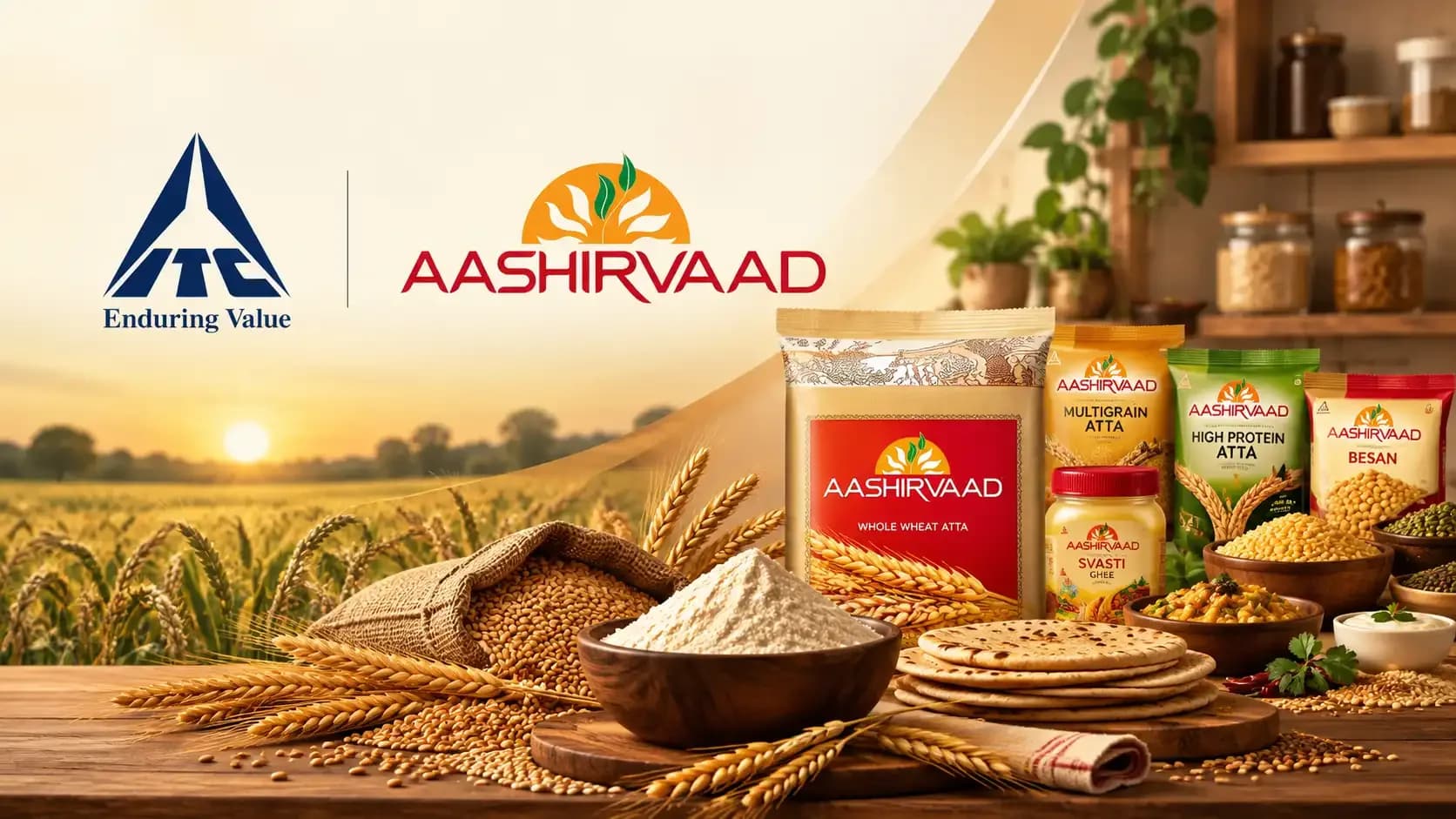
ITC is setting a significantly larger ambition for Aashirvaad: turning one of India's best-known packaged atta brands into a ₹20,000-crore consumer food platform.
The company expects consumer spending on Aashirvaad products to double from around ₹10,000 crore currently to ₹20,000 crore over the next five years, according to Hemant Malik, Executive Director and CEO of ITC's Foods Division. The ambition comes as ITC expands Aashirvaad beyond its traditional atta franchise into staples, nutrition, ready-to-cook products, frozen foods and fresh food.
But there is an important distinction in that number.
₹20,000 crore refers to consumer spending, not Aashirvaad's reported revenue. It represents the value consumers spend on the brand's products, including elements such as channel margins and taxes. For a business story, therefore, the ₹20,000-crore figure should not be described as a revenue target.
The larger story is what ITC is attempting to do with the brand: move Aashirvaad from being synonymous with atta to becoming a much broader Indian food platform.
From atta to an entire Indian kitchen
Aashirvaad began in 2002 as ITC's packaged atta brand. Over the years, the company has steadily expanded the brand into products that sit alongside atta in the Indian kitchen.
The portfolio now extends across products such as besan, rava, vermicelli, soya chunks, organic dals, organic atta, millet-based products, gluten-free flour and specialised atta variants. ITC has also expanded into convenience and nutrition-led products, including ready-to-cook chapatis, frozen naans and parathas and High Protein Atta.
That expansion is central to the ₹20,000-crore ambition.
A household can only consume a finite amount of wheat flour. If Aashirvaad wants to double consumer spending, simply selling more traditional atta is unlikely to be enough.
The bigger opportunity is to increase the number of food occasions and categories in which consumers choose Aashirvaad.
In other words, ITC is trying to increase Aashirvaad's share of the Indian kitchen, rather than simply its share of the atta market.
The numbers behind the ambition
The current consumer-spend base of around ₹10,000 crore needs to reach ₹20,000 crore in five years.
That implies an approximate 14.9% CAGR in consumer spending.
Metric | Details |
|---|---|
Current Aashirvaad consumer spending | ~₹10,000 crore |
Five-year target | ₹20,000 crore |
Implied CAGR | ~14.9% |
Brand launched | 2002 |
Aashirvaad portfolio | 200+ SKUs |
Manufacturing facilities | 66 |
Value-added variants & staples adjacencies | ~3x growth in five years |
Portfolio salience of these adjacencies | ~16% in FY26 |
ITC said its value-added variants and staples adjacencies have grown threefold over the past five years, while their salience in the portfolio has doubled.
That is significant because it shows the shift is already underway rather than being purely a future strategy.
The premiumisation of India's most basic staple
For decades, atta was largely treated as a commodity.
Consumers compared brands primarily on parameters such as:
price, wheat quality, freshness and taste.
ITC is trying to change that equation.
Aashirvaad now has products designed around specific consumer needs, including:
Multigrain Atta
Select Atta
Sugar Release Control Atta
High Protein Atta
Organic Atta
Ragi flour
Gluten-free flour
Millet-based products
The company's High Protein Atta, for instance, uses wheat along with soya, Bengal gram and oats. Aashirvaad says the product contains approximately 14.7 grams of protein per 100 grams, with three rotis providing about 13.2 grams of protein.
The strategy is clear: instead of simply charging a premium for "better atta", ITC is trying to create products with a specific functional benefit.
Protein, fibre, millets, organic ingredients and convenience give the consumer a reason to trade up.
Convenience is becoming the next growth engine
Perhaps the most important change in the Aashirvaad portfolio is its move from ingredients to solutions.
ITC has been expanding its Ready-to-Cook Chapati offering, targeting consumers who want the convenience of packaged food without giving up the familiarity of fresh rotis.
According to Hemant Malik, the product has a shelf life of around five days, requires refrigeration and is designed to be placed directly on a tawa for preparation. It was initially launched in Kerala and has expanded to Bengaluru, with Mumbai and Delhi planned.
This is a fundamentally different proposition from a bag of atta.
The consumer isn't buying an ingredient.
They are buying back time.
That distinction could become increasingly important as India's urban food consumption changes, with more dual-income households, smaller households and consumers looking for convenient meal solutions.
Aashirvaad is also entering nutrition
Protein has become one of the most important themes in India's packaged-food market, and ITC is positioning Aashirvaad directly within that trend.
The company launched Aashirvaad High Protein Atta as part of its broader nutrition strategy. It has also expanded into protein-oriented products such as soya chunks and recently launched Aashirvaad Chana Sattu in select eastern markets.
The sattu launch is particularly interesting.
Sattu has deep roots in Indian food culture, especially in eastern India, but ITC is positioning it within a contemporary nutrition proposition.
The strategy effectively takes a traditional food and gives it a branded, packaged and scalable format.
That could become a major opportunity for Indian FMCG companies: taking regional foods that already have cultural credibility and building national packaged-food categories around them.
From pantry staples to frozen foods
Aashirvaad's expansion isn't limited to flour and nutrition.
ITC has also been pushing convenience through frozen naans and parathas, while its wider frozen-food portfolio under ITC Master Chef now has more than 80 products spanning Indian and international food occasions.
The broader strategy is to capture occasions that traditionally required preparation at home.
The consumer journey increasingly looks like this:
Buy ingredients → prepare food
becoming
Buy partially prepared food → finish at home
and, increasingly,
Buy ready-to-eat food → consume immediately.
For ITC, each step creates another potential consumption occasion.
The fresh-food experiment
The company's most ambitious move may be its push into short-shelf-life fresh foods.
ITC has introduced products such as fresh chapatis, chutneys, snacks and cookies.
The supply-chain challenge is considerably greater than in conventional FMCG because these products have much shorter shelf lives.
Malik told Financial Express that Aashirvaad's ready-to-eat chapatis have a five-day shelf life, while some fresh chutneys have a shelf life of around 15 days. Demand forecasting and replenishment therefore become critical.
ITC is also building a wider fresh-food ecosystem through delivery platforms under brands including Aashirvaad Soul Creations, Sunfeast Baked Creations, ITC Master Chef Creations and Sansho by ITC Master Chef.
This takes ITC much closer to the boundary between FMCG and food service.
Why ITC has an advantage
Aashirvaad is not attempting this expansion like a young food startup.
It already has the infrastructure.
ITC's FMCG portfolio of more than 30 brands reached nearly 280 million households in FY26, while the company's FMCG business generated ₹24,210 crore in segment revenue during the year. Its broader portfolio represented annual consumer spending of nearly ₹37,000 crore.
That gives Aashirvaad access to:
Distribution
Manufacturing
Procurement
Retail relationships
Brand-building capabilities
Digital and quick-commerce channels
and, importantly, ITC's agricultural sourcing ecosystem.
For a new food brand, building that infrastructure can take years and require significant capital.
Aashirvaad can use an ecosystem that ITC has already spent decades building.
The unorganised-food opportunity
There is another structural reason behind ITC's optimism.
India remains a relatively underpenetrated market for branded packaged food compared with more developed markets.
Hemant Malik has estimated packaged-food penetration at around 14–15%, pointing to significant room for consumers to shift from unbranded and unpackaged products towards branded offerings.
This is particularly relevant for categories such as:
flour
spices
pulses
regional staples
snacks
fresh foods
Aashirvaad's opportunity is therefore not only to take share from rival packaged-food brands.
It can also potentially convert unbranded consumption into branded consumption.
That is a much larger pool.
The mother-brand strategy
This is arguably the most important strategic element of the story.
Aashirvaad has built strong consumer recognition around a simple proposition: everyday Indian food.
ITC can now use that trust to enter adjacent categories.
Think of the consumer's kitchen:
Atta → Besan → Rava → Vermicelli → Soya Chunks → Dals → Organic Products → Spices → Ready-to-Cook → Frozen → Nutrition → Fresh
The more categories Aashirvaad can credibly enter, the greater the potential value of the brand.
This is the classic mother-brand strategy: build one trusted brand and extend it across multiple categories rather than creating a new brand for every product.
But there is a fine line.
The further Aashirvaad moves from its core, the more important brand credibility and product quality become.
Consumers may naturally associate Aashirvaad with atta and staples. They may be less willing to automatically transfer that trust to every new category.
That makes execution just as important as innovation.
ITC's broader FMCG transformation
The Aashirvaad strategy is also part of a much larger transformation at ITC.
The company has spent years reducing its dependence on cigarettes by building businesses across foods, personal care, stationery, dairy, snacks, noodles and other consumer categories.
ITC's FMCG revenue has grown substantially over the past five years, reaching ₹24,210 crore in FY26, up from around ₹14,730 crore in FY21 — a five-year CAGR of about 10.5%.
Chairman Sanjiv Puri has also said ITC sees an addressable packaged-goods market of around ₹8 lakh crore by 2035, reflecting the company's confidence in the long-term expansion of India's branded-consumption market.
The company has committed around ₹20,000 crore of medium-term investment across the group, with FMCG among the key growth areas.
So Aashirvaad's ₹20,000-crore ambition sits within a much larger corporate strategy: build scalable consumer businesses that can compound as India's packaged-food market expands.
But there are risks
The opportunity is substantial, but doubling consumer spending in five years will not be straightforward.
1. Atta is already a mature category
There is a natural ceiling to volume growth in basic flour. Much of the incremental growth must therefore come from premiumisation and new categories.
2. Brand stretching
Aashirvaad needs to ensure that consumers see every new product as a natural extension of the brand.
3. Fresh-food complexity
Short shelf-life products require highly precise demand forecasting, manufacturing and distribution.
4. Competition
Aashirvaad competes with established FMCG brands as well as regional manufacturers, local mills and increasingly aggressive new-age food companies.
5. Premiumisation has limits
Consumers may pay more for genuine health and convenience benefits, but the proposition has to deliver tangible value.
6. Regional diversity
India isn't one food market.
Taste preferences, wheat varieties, cooking habits and staple foods differ significantly across states. A national Aashirvaad strategy will therefore need considerable localisation.
The bigger food-industry story
The most interesting aspect of Aashirvaad's ₹20,000-crore ambition is what it says about the evolution of Indian food itself.
Traditional staples are becoming branded.
Regional foods are becoming packaged.
Basic ingredients are becoming nutrition products.
Cooking ingredients are becoming convenience solutions.
And FMCG companies are increasingly trying to own the entire journey from farm to kitchen to plate.
Aashirvaad is a particularly strong example because it began with perhaps the most basic product in the Indian kitchen: atta.
Twenty-four years later, ITC is attempting to turn that foundation into a much broader food ecosystem.
The next five years will determine whether consumers are willing to make that journey with it.
The ₹20,000-crore question
ITC doesn't need Indian households to suddenly eat twice as much atta.
It needs them to buy more things from Aashirvaad.
That is the real strategy behind the number.
From atta to protein, from staples to convenience, and from packaged foods to fresh meals, ITC is betting that one of India's most familiar food brands can become something much bigger.
Aashirvaad's next chapter isn't really about selling more flour. It's about owning a larger share of the Indian kitchen.
Note: The ₹20,000-crore figure refers to estimated consumer spending on Aashirvaad products, not the brand's reported accounting revenue. The five-year CAGR of approximately 14.9% is a calculation based on the reported ₹10,000-crore current base and ₹20,000-crore target.