

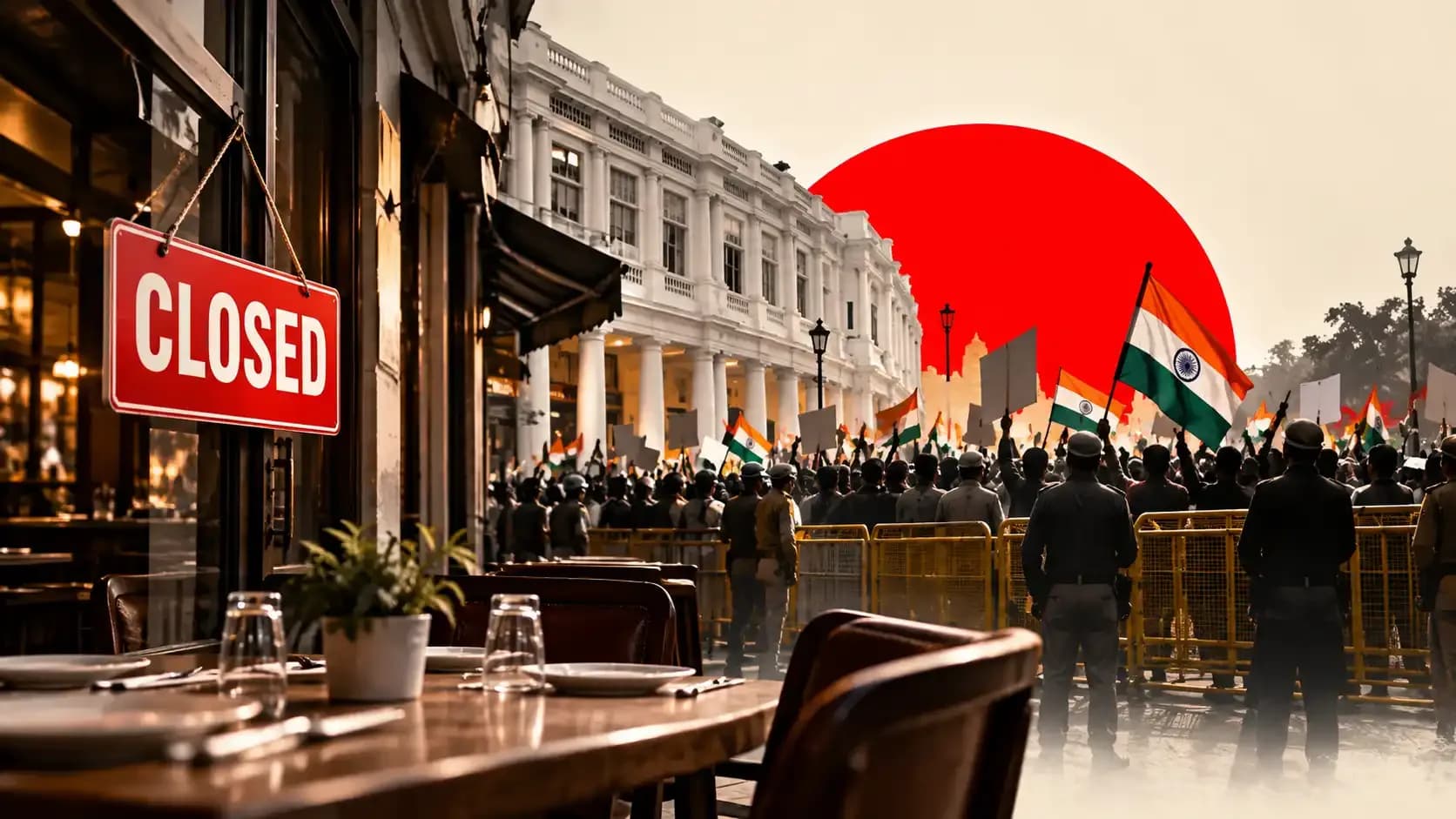
When politics takes centre stage, who stands up for restaurants?
A restaurant can spend years building its reputation, investing in staff, securing suppliers and earning customer trust. Yet a few hours of disruption can put that entire business model under pressure.
That is the concern now emerging from Connaught Place, Delhi, where a restaurant owner has approached the Delhi High Court over alleged business losses linked to the Cockroach Janta Party (CJP) protest held on October 10.
The dispute has brought an uncomfortable question into focus for India's restaurant and hospitality industry: when political protests disrupt business, who pays the price — and who is accountable for the losses?
According to reports, traders' associations have estimated losses of ₹150–200 crore in Connaught Place alone, while commercial activity worth approximately ₹2,000 crore was reportedly affected across Delhi.
These figures have not been independently audited or established as proven losses by a court. Nevertheless, the claims underline the concerns of businesses operating in one of the capital's busiest commercial districts.
For restaurants, the issue is not political ideology. It is whether they can keep their doors open, serve customers, pay employees and meet financial commitments when circumstances beyond their control disrupt operations.
A restaurant owner takes the fight to court
The legal challenge has brought Minar Restaurant, associated with petitioner Aayush Chopra, into the centre of the debate.
According to published reports, Chopra has sought intervention from the Delhi High Court over the alleged disruption caused by the October 10 protest. His petition reportedly seeks measures to prevent unauthorised gatherings from disrupting businesses, as well as a mechanism to assess losses and consider compensation from parties found legally responsible.
The case is significant because it puts the commercial consequences of public demonstrations before the judiciary.
Restaurants operate on tight daily calculations. Rent, salaries, electricity, ingredients, delivery commissions and supplier payments do not stop simply because customers cannot reach an establishment.
A restaurant that loses an evening's business may recover some sales later. But wasted ingredients, cancelled reservations, idle staff hours and lost customer visits can translate into costs that cannot always be recovered.
For smaller restaurants, even a short interruption can put pressure on already limited cash reserves.
The petitioner's precise individual losses have not been independently established in the reporting reviewed. Nor has the court ruled that CJP or any other party is liable to pay compensation.
But the legal question is now clear: what remedy should be available when a business can demonstrate that unlawful actions have caused financial harm?
₹2,000 crore in affected business: Who is counting the cost?
The numbers being cited by traders are substantial.
Associations have estimated that Connaught Place businesses suffered losses of ₹150–200 crore, while the Chamber of Trade and Industry has cited approximately ₹2,000 crore in commercial activity affected across Delhi.
For the restaurant industry, these estimates raise serious concerns about the vulnerability of businesses to large-scale disruptions.
However, affected turnover and actual financial losses are not the same thing. Some customers may postpone a visit, while others may choose another location. Some sales may be recovered later; others, particularly those involving perishable food and time-sensitive restaurant bookings, may be lost permanently.
A credible assessment would require evidence from restaurant sales records, cancelled reservations, delivery platforms, supplier invoices and comparable trading periods.
Until such evidence is available, the figures should be understood as traders' estimates rather than a final measure of proven damage.
Still, the absence of a verified total does not make the underlying concern insignificant. It makes transparent measurement and accountability more important.
Restaurants cannot put their expenses on pause
For a restaurant, a shutdown is rarely limited to lost revenue.
Food purchased for the day may spoil. Kitchen staff and service teams may still need to be paid. Suppliers may expect payment regardless of customer footfall. Delivery orders can be cancelled, and customers who encounter repeated access problems may decide not to return.
The impact can extend to the wider food-service ecosystem: distributors, wholesalers, food producers, delivery partners and contract workers.
The burden is not distributed equally. A large hospitality chain may have the financial capacity to absorb a temporary disruption, while an independent restaurant may operate on much thinner margins.
Street-food vendors and small eateries can be particularly exposed because their earnings depend heavily on daily sales.
This is why the debate should not be reduced to a contest between political supporters and opponents. The economic consequences for businesses and workers deserve independent scrutiny, irrespective of the cause being championed.
The Supreme Court's observations raise the stakes
The Supreme Court has indicated, according to reports published on October 16, that compensation may be considered if restrictions imposed on businesses are found to be unlawful or disproportionate.
The observation brings the issue of economic accountability into sharper focus. However, it is not a final order awarding compensation, nor does it establish that the protest organisers or the authorities are legally responsible for the reported losses.
That distinction matters.
The right to peaceful assembly is constitutionally protected, subject to lawful restrictions. Businesses also have constitutional protections relating to the freedom to carry on a trade or business, and the right to life under Article 21 has broader implications for livelihood.
The legal challenge is not about whether citizens should be allowed to protest. It is about how the right to protest can be exercised while respecting other people's rights, and what happens when unlawful conduct or disproportionate restrictions cause demonstrable economic harm.
If compensation is eventually considered, the courts will need to examine the evidence, the cause of the losses and the legal responsibility of the parties involved.
Protest organisers or the authorities: Who should answer?
CJP, led by Abhijeet Dipke, organised the demonstrations around demands for the resignation of Chief Election Commissioner Gyanesh Kumar. The protests were connected to allegations concerning electoral-roll revisions.
Dipke has disputed the suggestion that protesters should automatically be held responsible for the economic impact, arguing that government restrictions and security measures also contributed to the disruption.
That raises a legitimate question about causation.
If protesters unlawfully obstruct access to commercial premises, that conduct may be relevant to questions of liability. If police barricades or administrative restrictions prevent customers from reaching businesses, the legality and proportionality of those measures may also require examination.
In some circumstances, multiple factors may contribute to the same loss.
The presence of a protest does not automatically establish that its organisers are responsible for every financial consequence. Equally, invoking public safety does not remove the need to examine whether restrictions were lawful and proportionate.
For restaurants and traders, what matters is that the investigation does not stop at assigning political blame. It must establish what happened, who was responsible and whether affected businesses have a legal route to seek redress.
India's restaurant industry needs a stronger framework for business continuity
The dispute exposes a broader weakness in the way commercial districts prepare for major demonstrations and other public disruptions.
Restaurants and retailers need clear communication about road closures, access restrictions and the expected duration of disruptions. Authorities should consider practical arrangements that preserve access to commercial premises wherever public safety allows.
Businesses also need clarity about the process for reporting losses and the evidence required when seeking legal relief.
Such measures would not guarantee that every restaurant avoids financial damage. Nor would they justify restricting peaceful demonstrations simply because commercial activity may be affected.
They would, however, help reduce avoidable disruption and provide greater predictability for establishments employing workers and serving local communities.
A city that accommodates democratic protest while protecting legitimate economic activity is better placed to preserve both civic freedoms and livelihoods.
The question Indian Food Times believes deserves an answer
The CJP protest controversy is now about more than a political demonstration or a disputed estimate of financial damage. It has become a test of how seriously the economic interests of restaurants, retailers, workers and small businesses are taken when public order and political expression collide.
The reported ₹2,000 crore figure still requires careful verification. The restaurant owner's claims must be examined through the legal process, and responsibility cannot be assigned before the evidence is assessed.
But the restaurant industry's underlying concern deserves attention now.
Businesses should not have to choose between respecting democratic rights and protecting their own survival. Nor should the public assume that every loss claimed during a protest is automatically recoverable or that any one party is necessarily responsible.
The courts will have to determine the legal questions. Traders will need to substantiate the financial claims, and the authorities must account for the restrictions they impose.
For India's restaurant industry, the larger question remains: when a protest disrupts the businesses that feed a city, employ its people and sustain its local economy, who ensures that their losses do not simply become the cost of doing business?