
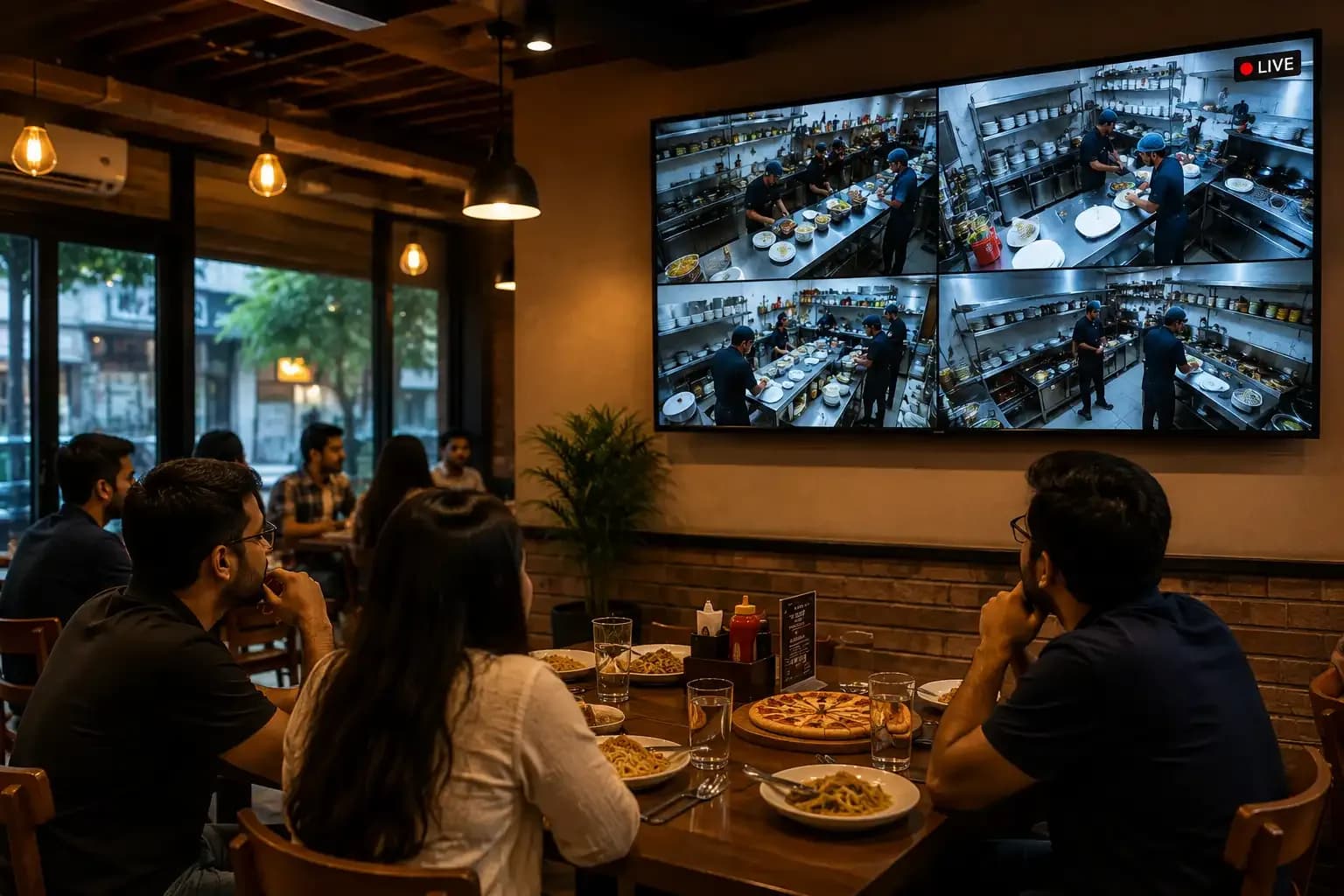
In a move that could significantly change how customers see restaurant kitchens, the Ahmedabad Municipal Corporation (AMC) has issued an advisory to 11,123 restaurants and food business operators, asking them to install CCTV cameras covering their kitchens and display the live footage near reception or customer seating areas.
The advisory was issued by the AMC’s Food Department on Wednesday, August 19, as the civic body intensified inspections of restaurants, eateries and institutional canteens across the city.
The idea is straightforward: customers should be able to see what is happening inside the kitchen where their food is being prepared.
Customers Could Get a Live View of Restaurant Kitchens
Under the AMC's directive, CCTV cameras are expected to cover kitchen areas, while the live feed should be displayed in a location accessible to customers, such as the reception or dining area.
The move is aimed at improving transparency around food preparation, kitchen cleanliness and hygiene practices.
For customers, this could mean being able to observe whether food handlers are maintaining basic hygiene, whether kitchen surfaces are clean and whether obvious sanitation problems are taking place.
The AMC has simultaneously reminded food businesses about several existing food-safety requirements, including personal hygiene of food handlers, separation of raw and cooked food, safe storage, use of clean water, pest control, waste disposal and regular cleaning and sanitisation of utensils and equipment.
The Timing Is Significant
The CCTV advisory comes as Ahmedabad's civic authorities have stepped up enforcement against restaurants and other food businesses.
On August 19, AMC teams reportedly sealed multiple establishments following inspections that found alleged hygiene, food-quality, adulteration and licensing violations.
Among the reported cases were establishments where officials found pest-related concerns, suspected adulteration in ghee, failed paneer samples and unhygienic kitchen conditions.
AMC has also expanded inspections beyond restaurants to school and college canteens and other institutional food facilities.
One reported case involved the Mahatma Gandhi Physiotherapy College Hostel canteen in Saijpur Bogha, which was sealed after officials reportedly found insects in food along with hygiene and documentation-related violations.
What Restaurants Are Being Told to Follow
The AMC's advisory places emphasis on basic food-safety and hygiene practices, including:
Maintaining clean and sanitary kitchens
Ensuring personal hygiene among food handlers
Keeping raw and cooked food separate
Using safe water
Maintaining proper food storage
Conducting pest-control measures
Proper disposal of food and other waste
Regular cleaning and sanitisation of utensils and equipment
Protecting food from dust and contamination
Using permitted food colours and ingredients
Following appropriate practices for cooking oil
These requirements broadly correspond with India's existing food-safety framework.
FSSAI states that licensed food businesses must maintain a documented Food Safety Management System (FSMS) and comply with Schedule 4 hygiene requirements. Part 5 of Schedule 4 specifically covers catering establishments, including restaurants, hotels, snack bars and canteens.
Is Kitchen CCTV a New FSSAI Rule?
Not exactly.
This is one of the most important distinctions surrounding the development.
While several reports have described the AMC's CCTV directive as mandatory for restaurants in Ahmedabad, the CCTV/live-stream requirement itself should not be presented as a new nationwide FSSAI rule.
FSSAI's current hygiene framework requires food businesses to follow food-safety and hygiene standards, but the regulator's published hygiene requirements do not establish a general requirement for restaurants across India to install kitchen CCTV and livestream it to customers.
The present initiative is an Ahmedabad Municipal Corporation measure, meaning it should not be interpreted as a nationwide CCTV mandate for every restaurant in India.
Can CCTV Really Guarantee Food Safety?
This is where the initiative gets interesting.
A live kitchen camera can potentially show customers:
What it CAN show:
Visible kitchen cleanliness
Food-handling practices
Personal hygiene
Obvious pest activity
General sanitation conditions
Whether workers are following basic handling practices
But CCTV cannot establish whether:
Paneer has been adulterated
Ghee contains vegetable oil
Cooking oil has crossed permissible limits
Water is microbiologically safe
Food contains harmful contaminants
Ingredients meet laboratory standards
Those issues require food sampling, laboratory testing and regulatory inspection.
In other words, a clean-looking kitchen on a television screen does not necessarily mean that every ingredient being used is safe.
Why This Could Be a Bigger Move Than It Looks
The Ahmedabad initiative represents an interesting shift in food-safety transparency.
Traditionally, restaurant kitchens operate largely behind closed doors. Customers see the final plate, while regulators see the kitchen during inspections.
AMC's proposal introduces a third layer:
The customer gets to see the kitchen too.
That could create additional pressure on restaurants to maintain hygiene throughout the day—not just when an inspector is expected.
It could also become a reputational tool. A restaurant with a visibly clean and well-managed kitchen could use that transparency to build customer confidence.
But there is another side.
Restaurants may have concerns around privacy, operational practices, employee monitoring, camera placement, costs and whether a live feed can genuinely measure food safety.
Could Other Indian Cities Follow Ahmedabad?
That may be the biggest question now.
If the Ahmedabad model proves effective, other municipal corporations could consider similar transparency measures for restaurants and food businesses.
India already has consumer-facing food-safety initiatives such as FSSAI's Hygiene Rating Scheme, while its regulatory framework requires food businesses to maintain appropriate hygiene and food-safety systems.
Kitchen CCTV could potentially become another layer of transparency—but whether it becomes a wider model will depend on how effectively Ahmedabad implements and enforces it.
For now, however, the development is significant: 11,123 food businesses in Ahmedabad have been put on notice to make their kitchens more visible to the very people eating the food.
And if the cameras really go live across the city, Ahmedabad could become a real-world test of a simple but powerful question:
What happens when restaurant kitchens are no longer hidden from customers?