


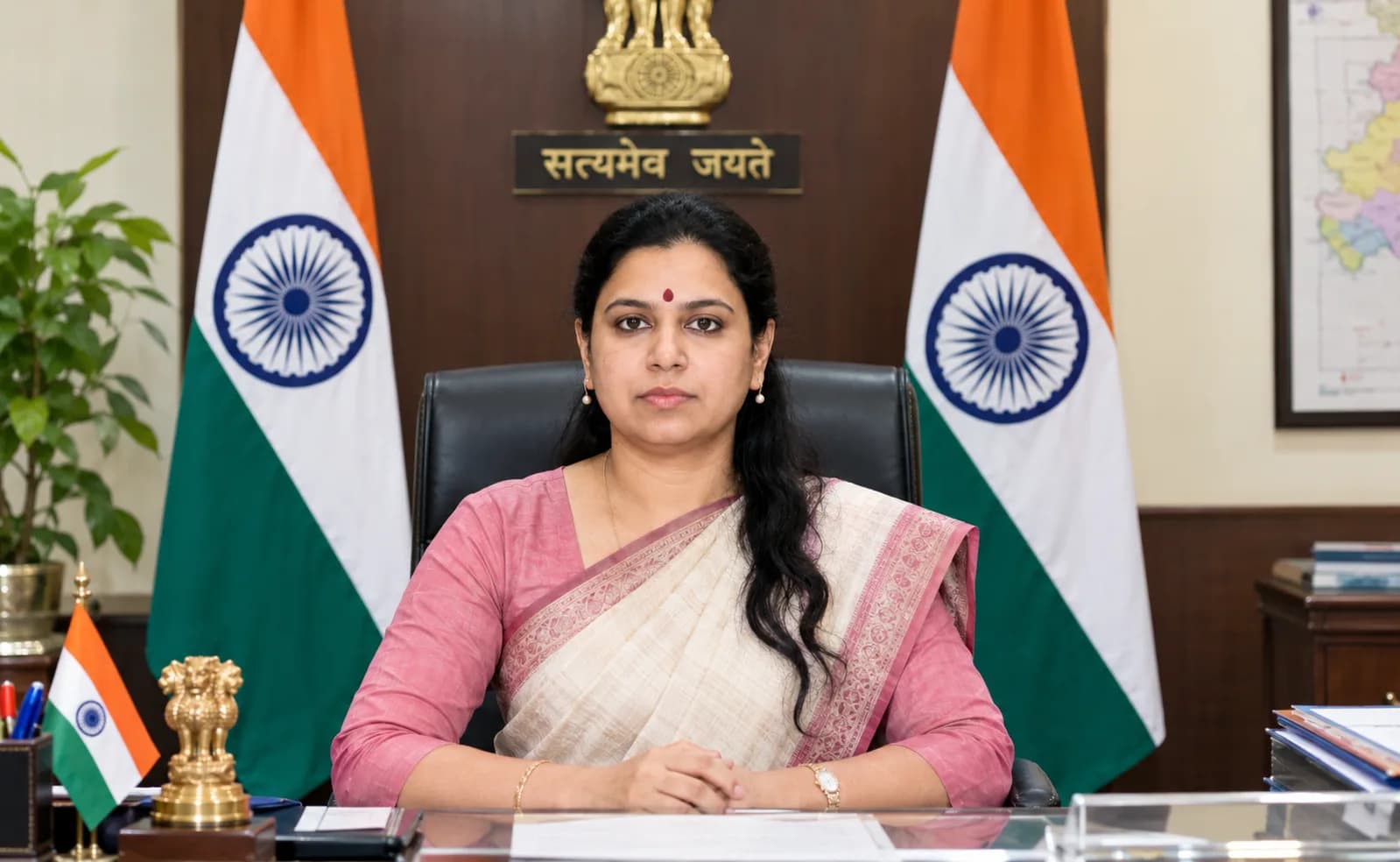
A village waited 76 years for water. A district magistrate helped make it happen. An elderly woman touched her head and blessed her without saying a word. Days later, the officer was transferred out.
Three years after that, she resigned from the IAS altogether and named that same blessing as the moment she carries with her.
Everyone online has an explanation for why. Almost no one has laid out what's actually documented in between.
The old woman didn't say a word.
She had waited her whole life for this moment for water to run, on its own, into her home, in a hilltop village that India's freedom had somehow forgotten to reach for 76 years. When it finally happened, on a August afternoon in 2023, she didn't cheer. She didn't cry out. She reached up with trembling hands, touched the head of the young officer standing in front of her, and blessed her in silence.
Three years later, that officer would remember this exact moment and only this moment as the one thing she carried with her on the day she quit the Indian Administrative Service for good.
Her name is Divya Mittal. On August 30, 2026, after thirteen years as one of Uttar Pradesh's most talked-about bureaucrats, she resigned. No scandal. No inquiry. No public blowup. Just a long, emotional post in Hindi on X, and a single line that stopped an entire state's political and administrative establishment mid-scroll:
"Today I have voluntarily resigned from the IAS, bringing an unforgettable 13-year journey to a close."
Within hours, the story was everywhere. Journalists, villagers, opposition leaders, ruling-party loyalists, IAS aspirants, and total strangers online were all asking the same question.
Why now? Why her? And what really happened in the three years between the day she brought water to a forgotten village and the day she walked away from public service altogether?
Most of the coverage that followed answered this with a single tidy sentence: she was punished for doing good work, so she quit. It's a satisfying story. It fits neatly into 280 characters. And it may even be partly true.
But the real, documented timeline is messier, more human, and far more interesting than the version currently circulating on social media. Indian Food Times spent time pulling that timeline apart, piece by verifiable piece.
A Village Called "Tanker Village"
To understand why this story struck such a nerve, you have to first understand Lahuria Dah.
It's a small hamlet perched on a hilltop on the Uttar Pradesh–Madhya Pradesh border, deep inside Mirzapur district home to roughly 1,200 to 1,500 people from the Kol, Dharkar, Yadav, Pal and Kesharwani communities, among the most underdeveloped pockets of eastern Uttar Pradesh. For generations, the only water source was a natural spring that ran dry every summer like clockwork. When it did, the only option left was paid water tankers a recurring cost so heavy that residents said it consumed their entire household budgets year after year.
There had been an attempt to fix this once before. About a decade earlier, a pipeline project was started and then simply abandoned halfway, undone by poor planning. For reasons that remain unclear in the public record, Lahuria Dah wasn't even included in the government's flagship Jal Jeevan Mission, the national scheme meant to bring piped water to every rural household.
So the village waited. And waited. Long enough that locals began calling it, bitterly, the "tanker village." Long enough that some residents later said families were reluctant to marry their daughters into the community, because life there revolved entirely around the daily hunt for water.
Then, in September 2022, Divya Mittal arrived as the new District Magistrate of Mirzapur.
Nine Months, One Tap, and a Village That Wept
Mittal was, by most accounts, not a typical desk-bound administrator. She had an unusual résumé for a district magistrate an engineering degree from IIT Delhi, an MBA from IIM Bangalore, a corporate career at JP Morgan in London and a reputation, wherever she was posted, for showing up in person rather than issuing orders from an office.
She later described her first visit to Lahuria Dah in blunt, personal terms: she said she couldn't bring herself to drink from her own water bottle in front of villagers who had none. That discomfort, by her own account, became the starting point of a project her team spent nine months fighting through geography, funding gaps, and the sheer physical difficulty of routing pipelines uphill to a settlement that engineers had once written off as impossible to serve.
On August 30, 2023, it happened. Taps opened across the village for the very first time. Water clean, piped, and free of the tanker economy that had governed daily life for generations reached every home under the "Har Ghar Jal" scheme.
Mittal marked the occasion with a small "jal pujan," a water-blessing ceremony, alongside the villagers. In her own words on social media that day:
"Even after 75 years of Independence, people of Lahuria Deh village, Mirzapur did not have access to water… Today, that changed."
It was, by every account hers, the villagers', and the journalists who covered it in real time a genuinely emotional moment. Locals described it as nothing short of a miracle.
It would also turn out to be the beginning of the end of her time in Mirzapur.
The Transfer and Two Very Different Stories About Why
Here is where the story stops being simple.
Within days of the ceremony, word began circulating that a formal complaint had been filed alleging that the "jal pujan" had violated protocol, and that local elected representatives had not been invited to the event. According to one detailed account, a local BJP leader named Vipul Singh wrote directly to Chief Minister Yogi Adityanath, arguing that a government representative not the District Magistrate should have performed the ceremony, and that the local MLA and MP had been left out entirely.
Soon after, Mittal was transferred out of Mirzapur. Reports at the time suggest the transfer order was briefly put on hold — reportedly between September 4, 2023 and February 1, 2024 before ultimately taking effect.
But that isn't the only version of events in circulation.
A separate account, reported years later around the time of her 2026 resignation, points to a different set of names entirely — tension, according to unnamed government sources, with Apna Dal (Soneylal) MP and Union Minister of State Anupriya Patel, and her husband, UP minister Ashish Patel. In this telling, it was Anupriya Patel who was allegedly excluded from the same ceremony, and it was that slight, not a BJP local leader's letter, that triggered the fallout.
Both versions describe the same underlying pattern: a complaint tied to the same water ceremony, followed by a transfer that stunned and upset the village. Neither has been confirmed through an official government statement, an on-record complaint, or a published transfer order explaining the reason in writing. Indian Food Times could not independently verify which account if either, or both is accurate. Readers should treat this detail for what it currently is: a widely reported claim, not an established fact.
What villagers remember most clearly isn't the politics it's the goodbye. In a farewell organised by Mirzapur residents in September 2023, Mittal was showered with flower petals, visibly emotional, in a scene that later went viral in its own right.
Then Someone Cut the Pipeline
Just days after the transfer controversy broke, another development occurred one far less discussed in the retrospective coverage of her resignation.
Contemporaneous reporting from early September 2023 recorded that the newly laid pipeline supplying Lahuria Dah was deliberately damaged by unidentified "anti-social elements" on September 4, 2023 cutting off the very water supply the village had just celebrated. For a community that had waited 76 years, it was, in the words of one resident at the time, like losing something they had just found.
The system was reportedly restored afterward. Later reporting, from April 2024, found the village still celebrating continuous piped water supply, eight months on evidence that whatever damage occurred, it did not permanently derail the project. But the specific motive behind the vandalism, and whether anyone was ever identified or held accountable for it, does not appear to have been publicly established. Public records reviewed for this story do not confirm a resolution to that incident.
Deoria, Lucknow, and a Career That Kept Moving
Mittal's career did not end in Mirzapur far from it.
She went on to serve as District Magistrate of Deoria starting in July 2024, where she reportedly earned praise for a large-scale effort to reclaim government land that had been illegally encroached upon, restoring public spaces for local communities. In May 2026, she was moved again this time to Lucknow, as Special Secretary in the Uttar Pradesh Revenue Department, a desk posting far removed from the field-heavy DM roles that had made her a familiar, almost folk-hero figure to ordinary residents.
Three months later, on August 30, 2026 almost exactly three years to the day after the taps first opened in Lahuria Dah she resigned.
As of that announcement, officials told the news agency PTI that the state government had not yet formally received her resignation letter, meaning the decision remains subject to the standard approval process, which requires a recommendation from the Uttar Pradesh government followed by a final decision from the Union Home Ministry. In administrative terms, as of this writing, Divya Mittal is not yet officially free of the IAS. Emotionally, she already sounds like she is.
What She Actually Said And What She Pointedly Did Not
This is the part that matters most, and the part most coverage has glossed over.
Mittal's resignation post does not blame anyone. It does not mention a transfer, a complaint, a politician, or any external pressure whatsoever. She described the decision as entirely her own the product of thirteen years of reflection, not a single triggering event.
She wrote about Deoria teaching her that "standing with what is right is not an option, but a duty." the end, she returned to the one image that seems to have outlaste She wrote about Mirzapur teaching her that "'impossible' is not a fact, but just an opinion." And then, neard every posting, every transfer, every political headline:
"That elderly mother from the hill of Lahuria Dah, who said nothing upon seeing water reach her village for the first time, but with trembling hands touched my head and gave her blessings. The position may be left behind today, but that touch will never leave me in this lifetime."
Speaking separately to the news outlet ThePrint after the post went viral, she was even more direct when asked whether something specific had pushed her out. "Nothing has triggered me," she said, adding only that she would "speak when the time comes" a line that has since fed widespread, and entirely unconfirmed, speculation that she may be preparing for a political career, possibly rooted in Mirzapur or Deoria, the two districts where she built her deepest public following. Mittal herself has not confirmed any such plan.
The Story Behind the Story
Strip away the speculation, and here is what can actually be said with confidence: a forgotten village got water after 76 years of being overlooked. A young, unusually hands-on officer made it happen in nine months. Days later, a ceremony triggered a political complaint the exact source of which is still genuinely disputed. A transfer followed. A pipeline was sabotaged, and then repaired. A career continued, quietly, for three more years, across two more districts. And then, without naming a single cause, she left it all behind carrying with her not a grievance, but the memory of one silent, trembling blessing on a hilltop most of India had never heard of.
Whether politics pushed her out, or whether thirteen years simply ran their course on their own terms, is a question the public record cannot yet answer with certainty.
What it can say, clearly, is this: somewhere between a tap turning on in 2023 and a resignation letter in 2026, something in Divya Mittal's relationship with the system she served for thirteen years quietly, irreversibly changed.
She just hasn't told us exactly what yet.