

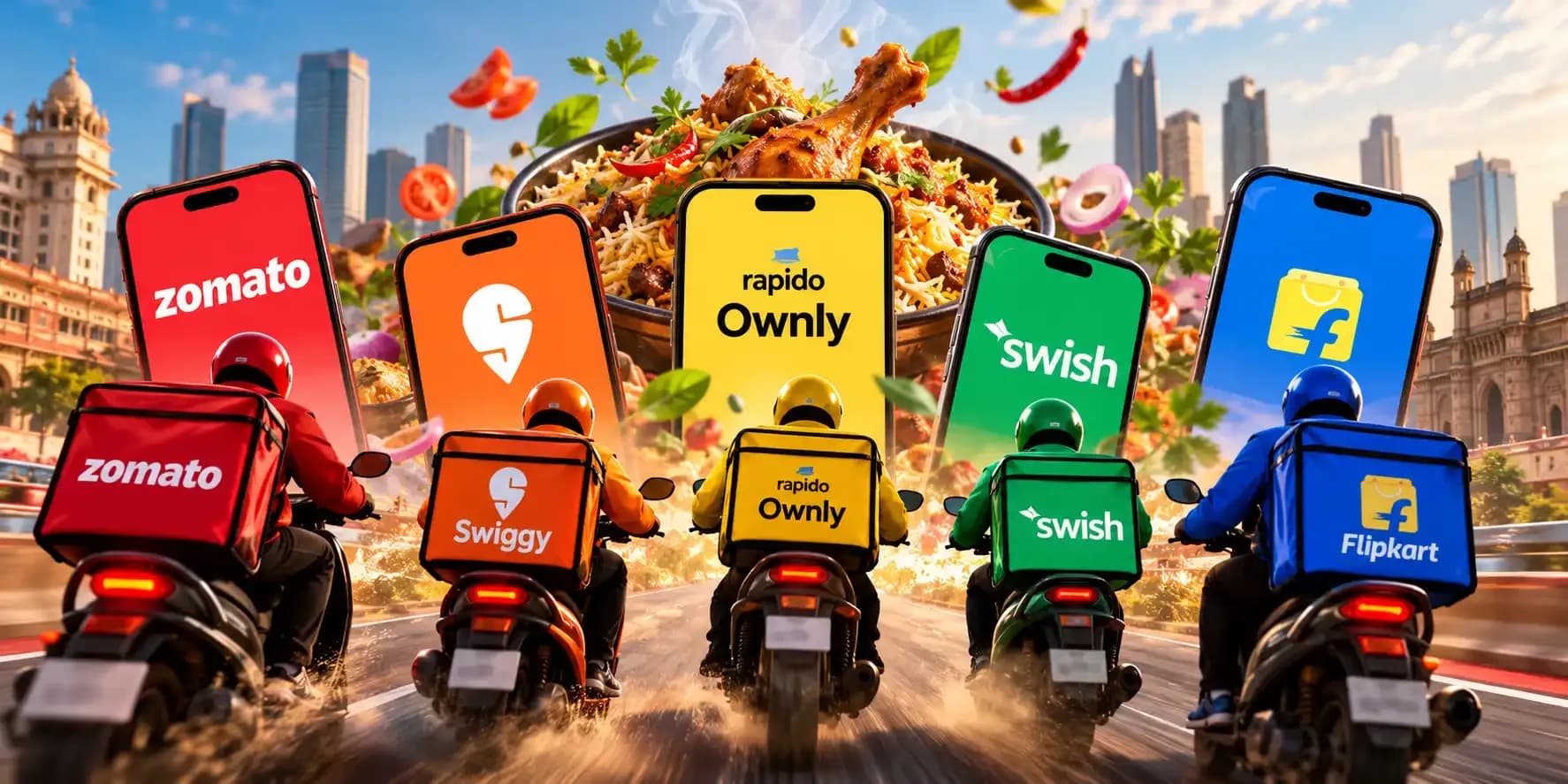
India’s food delivery market is getting crowded, but the real battle is no longer just about who can deliver a restaurant meal to your doorstep.
For years, Zomato and Swiggy have dominated the conversation around online food ordering. Their apps have become part of everyday life, connecting millions of customers with restaurants while building extensive delivery networks across Indian cities.
Now, a new set of competitors wants a share of that business.
Rapido has entered the market with Ownly, a platform built around a zero-commission proposition for restaurants. Bengaluru-based Swish is betting on freshly prepared food delivered in as little as 10 minutes. Meanwhile, Walmart-owned Flipkart is preparing to enter the category through a service reportedly called Eat-in by Minutes.
The competition is also coming from within the existing ecosystem. Swiggy is pushing its budget-focused Toing offering, while Eternal, the parent company of Zomato, has experimented with Bistro, a controlled food-preparation and delivery model.
Each company is approaching the opportunity differently. Some want to make online food ordering cheaper for restaurants and customers. Others want to control the kitchen, reduce delivery times or use an existing customer base to build a new business.
The question is whether India is witnessing the beginning of a genuine shift in food delivery economics or simply another round of competition in a market where scale, customer loyalty and operational efficiency remain difficult to replicate.
India’s food delivery market: The numbers behind the competition
The opportunity is substantial, but understanding its size requires distinguishing the overall food-services industry from the smaller market for digitally ordered restaurant meals.
According to an estimate cited by TechCrunch on October 19, 2026, India’s online food delivery market is growing at an annual rate of approximately 18–20%. Online delivery still accounts for just over 15% of the broader food-services industry, suggesting considerable room for further adoption.
The growth opportunity is not limited to customers switching between Zomato and Swiggy. It also includes consumers who continue to rely on neighbourhood restaurants, takeaway counters and offline ordering but could increasingly move towards digital platforms.
The following reported figures help illustrate the market’s scale.
Company or platform | Reported operating metric | Period and geography |
|---|---|---|
Swiggy | ₹9,005 crore in food-delivery gross order value (GOV) | Q4 FY2026, India |
Swiggy | 18.3 million average monthly transacting users in food delivery | Q4 FY2026 |
Rapido’s Ownly | More than 50,000 daily orders | August 2026, Bengaluru |
Swish | Approximately 20,000 daily orders | March 2026, Bengaluru |
Flipkart Eat-in by Minutes | Internal testing expanded to more than 8,000 employees | October 2026, Bengaluru |
These figures represent different reporting periods and geographies. They should not be treated as a direct market-share comparison.
Swiggy’s reported GOV, for example, represents the value of orders processed through its food-delivery platform. Ownly’s daily order count represents activity in Bengaluru. Neither metric, on its own, establishes a comparable national market share.
That distinction is important because a challenger can gain a meaningful position in one city without immediately threatening the national scale of established platforms.
Zomato and Swiggy: The incumbents still have a formidable advantage
Despite the arrival of new competitors, Zomato and Swiggy remain the central players in India’s online restaurant-delivery market.
Their advantages extend beyond the apps customers see on their phones. Both companies have spent years building restaurant relationships, delivery operations, customer-service systems, payments infrastructure and consumer trust.
Zomato’s food-delivery business recorded GOV of ₹9,778 crore in Q4 FY2025, while Swiggy reported ₹7,347 crore during the same quarter. These historical figures illustrate the scale of the two platforms, although they should not be used as an estimate of their current market shares in October 2026.
Swiggy’s subsequent performance also shows that the incumbent model continues to grow. Its food-delivery GOV reached ₹9,005 crore in Q4 FY2026, up 22.6% year-on-year. Average monthly transacting users rose to 18.3 million, while adjusted EBITDA reached ₹297 crore, equivalent to 3.3% of GOV.
These numbers demonstrate that restaurant delivery can generate positive adjusted operating earnings at scale.
However, the incumbents face a strategic challenge. Their established business models depend on balancing restaurant commissions, customer charges, delivery expenses, promotional incentives and order volumes. New entrants are attempting to find different combinations of these variables.
The response from established companies has already begun. Swiggy’s Toing and Eternal’s Bistro target affordability and new food occasions, indicating that the next phase of competition will not be limited to the companies entering from outside the existing duopoly.
Rapido’s Ownly: Can zero commission change the economics of food delivery?
Rapido’s Ownly is one of the most direct challenges to the conventional restaurant-aggregator model.
Traditional food-delivery platforms commonly charge restaurants commissions calculated as a percentage of order value, alongside other potential commercial charges. Ownly has instead positioned itself around a zero-commission proposition, aiming to help restaurants retain more of their sales revenue.
The approach addresses a long-standing concern among restaurant operators: online platforms can generate additional business, but the cost of acquiring and fulfilling those orders can put pressure on already thin margins.
Ownly’s reported growth
In August 2026, Moneycontrol reported that Ownly had crossed 50,000 daily orders in Bengaluru, roughly five months after its launch in the city.
The report estimated that Bengaluru handles approximately 500,000–600,000 food-delivery orders each day. Based on those estimates, Ownly’s daily volume represented roughly 8–10% of the city’s market, although the estimate was not an independently audited market-share figure.
The same report highlighted a broader response from the incumbents, with restaurant operators saying Zomato and Swiggy had become more proactive in their efforts to retain restaurant partners.
Ownly’s proposition is straightforward: lower platform costs could enable restaurants to offer more competitive menu prices, retain more revenue or both.
Consider a hypothetical restaurant order worth ₹300. If a platform charges a 25% commission, the restaurant would pay ₹75 before accounting for other costs. Under a fixed-fee arrangement of ₹25, the equivalent charge would be ₹50 lower.
This is an illustrative comparison, not a statement of the actual fee schedule or net earnings under either platform. Delivery expenses, taxes, packaging, promotions and other contractual terms can materially change the final economics.
What makes Ownly different?
Ownly is not simply trying to reproduce the Zomato experience with a different colour scheme. Its central competitive proposition is to change the commercial relationship between restaurants and the ordering platform.
If it can attract a broad restaurant selection while maintaining affordable delivery and a reliable customer experience, it could put pressure on the industry’s established commission structures.
But lower restaurant charges do not automatically create a sustainable platform.
Ownly must still pay for technology, delivery operations, customer acquisition, support, refunds and other costs. Its long-term success will depend on whether the business can support these expenses without relying indefinitely on promotional subsidies.
Ownly’s reported growth in Bengaluru is an early indication that customers and restaurants are willing to try an alternative. Its ability to reproduce those economics across multiple cities remains a key question.
Swish: A food-delivery company that controls the kitchen
While Ownly is challenging the economics of restaurant aggregation, Swish is approaching the market from a different direction.
Founded in 2024, the Bengaluru-based startup operates an end-to-end model encompassing its own kitchens, supply chain, ordering technology and delivery network.
Rather than depending on a large marketplace of independent restaurants, Swish focuses on compact neighbourhoods and operates with delivery radii of approximately one kilometre. The objective is to bring preparation and delivery closer together, reducing the time between an order being placed and the food reaching the customer.
Funding and operating scale
In March 2026, Swish raised $38 million in a Series B funding round led by Hara Global and Bain Capital Ventures, with participation from other investors. The round valued the company at approximately $139 million post-money and brought its total funding to $54 million.
According to TechCrunch, Swish was processing around 20,000 orders per day, up from approximately 5,000 four months earlier. It was operating across ten Bengaluru micro-markets and offering more than 200 items spanning meals, snacks and beverages.
The company reported an average order value of ₹200–250 and said some of its older kitchen clusters had reached profitability. However, it did not disclose the full per-order margin breakdown.
Why control over preparation matters
A conventional restaurant marketplace connects customers with independent food businesses. The platform typically does not control how every restaurant prepares its meals, manages ingredients or schedules its kitchen staff.
Swish exercises greater control over these processes. That can support consistent menus, standardised preparation, more predictable fulfilment and tighter coordination between the kitchen and delivery operations.
However, the model comes with a different set of costs.
Swish must manage kitchen rent, equipment, staff, ingredients, food wastage, quality control and compliance. It also needs sufficient demand throughout the day to keep its kitchens productive.
A kitchen that operates efficiently during lunch and dinner can still struggle if demand is weak during other periods.
Swish’s opportunity therefore depends on building repeat demand within dense neighbourhoods, maintaining high kitchen utilisation and expanding without allowing operational complexity to overwhelm its margins.
Its model is fundamentally different from that of a pure restaurant marketplace. Rather than simply competing for the same listings, Swish is trying to redesign how prepared food is produced and delivered.
Flipkart’s Eat-in by Minutes: The next challenger enters the picture
Flipkart’s reported food-delivery initiative could introduce another dimension to the competition.
On October 19, 2026, TechCrunch reported that the Walmart-owned e-commerce company was testing a food-delivery service internally in Bengaluru. The trial had expanded from a few hundred employees to more than 8,000, with a potential public launch being prepared.
The service reportedly appears as a separate tab within Flipkart’s main app under the name Eat-in by Minutes. The company is also reported to be deploying a dedicated food-delivery fleet through Ekart, its logistics arm.
The important distinction is that Eat-in by Minutes is a restaurant-food delivery proposition, while Flipkart Minutes is the company’s quick-commerce offering. Prepared meals require different operational processes from delivering packaged goods and groceries.
What could give Flipkart an advantage?
First, Flipkart already has an established consumer audience. It may be able to introduce food ordering to existing users without requiring them to discover an entirely new platform.
Second, the reported service draws on restaurant listings through the Open Network for Digital Commerce (ONDC), alongside restaurants onboarded directly by Flipkart. This provides a route to building supply through a combination of network participation and direct partnerships.
Third, Flipkart can potentially draw on its broader commerce and logistics infrastructure while developing a food-delivery operation tailored to restaurant orders.
But none of these advantages guarantees success.
The company must still demonstrate that customers will use the service repeatedly, that its restaurant selection is competitive and that the final checkout price is attractive. A customer who regularly buys electronics or other products on Flipkart may not automatically make it their preferred destination for lunch.
As of the latest reported information, a comparable national order volume, market share, average order value and food-delivery profitability for Eat-in by Minutes have not been established.
Flipkart is therefore a potential challenger rather than an established competitor with a measurable share of the restaurant-delivery market.
Toing and Bistro: The incumbents are also changing their strategy
The battle for affordable food delivery is not being fought exclusively by new entrants.
Swiggy’s Toing is a budget-focused offering designed to reach customers who are particularly sensitive to the final price of an order.
Eternal’s Bistro represents a different approach, using controlled food preparation and delivery to serve affordable meal and snack occasions.
These initiatives show that established platforms recognise the importance of reaching customers who may not order frequently at conventional restaurant prices.
Toing can potentially draw on Swiggy’s existing restaurant and delivery ecosystem. Bistro’s controlled-preparation approach offers greater influence over menu design, production and consistency, but it also introduces kitchen-utilisation and food-wastage risks.
The two services illustrate the range of strategies emerging within the industry. One approach is to improve affordability through a marketplace; the other is to exercise more control over the food being sold.
For the incumbents, the challenge is to create genuinely incremental demand rather than simply shifting existing customers from one service to another.
Who actually controls India’s food-delivery market?
The available data supports a clear conclusion: Zomato and Swiggy remain the established national-scale players, while the newer companies are developing their positions through different business models and concentrated city-level operations.
However, there is no verified, independently published October 2026 dataset that provides directly comparable national market shares for Zomato, Swiggy, Ownly, Swish, Flipkart Eat-in by Minutes, Toing and Bistro.
Assigning precise percentages to all these platforms would therefore create a misleading impression of certainty.
The available figures must be interpreted according to their definitions:
Gross order value (GOV): The total value of orders processed, rather than the platform’s revenue or profit.
Daily order volume: The number of orders handled over a period, which may be reported for a city or a national operation.
Monthly transacting users: The number of users who transact during a month, not the number of orders.
Market share: A percentage that requires a clearly defined market, measurement period and denominator.
Ownly’s estimated 8–10% share of Bengaluru’s food-delivery orders in August 2026 cannot be compared directly with a national GOV share for Zomato or Swiggy. Similarly, Swish’s daily orders cannot be added to the national marketplace denominator without accounting for its geography and the precise definition of an order.
For readers and investors, this distinction is essential. Growth in orders is evidence of traction, but it does not establish profitability, national scale or long-term market leadership.
The business models compared
The competitive landscape is becoming more diverse, with each player trying to solve a different problem.
Platform | Core strategy | Main advantage being pursued | Principal challenge |
|---|---|---|---|
Zomato | Restaurant marketplace | Scale, selection and customer familiarity | Sustaining growth and defending restaurant relationships |
Swiggy | Restaurant marketplace and wider convenience ecosystem | Delivery infrastructure and customer reach | Balancing growth, customer affordability and costs |
Ownly | Zero-commission positioning | Lower platform charges for restaurants | Covering delivery and operating costs |
Swish | Owned kitchens and hyperlocal delivery | Control over preparation, speed and consistency | Kitchen utilisation, food waste and expansion |
Flipkart Eat-in by Minutes | Food delivery within an existing commerce app | Customer distribution and logistics capabilities | Proving repeat usage and competitive fulfilment |
Toing | Budget-focused marketplace | Reaching price-sensitive consumers | Generating incremental demand |
Bistro | Controlled food preparation and delivery | Menu control and standardised operations | Maintaining productive kitchens and sustainable margins |
These models are not interchangeable. A marketplace can expand restaurant selection without owning every kitchen. A controlled-kitchen company can standardise preparation but must carry more direct operating costs. A commerce platform can potentially reach existing customers more efficiently but still has to earn a place in their daily food-ordering habits.
The winners will be determined by the relationship between these advantages and the cost of delivering each order.
What will decide the next phase of the food-delivery war?
1. Restaurant profitability
Restaurants will increasingly compare platforms based on the business they generate and the amount they retain after commissions, promotions, packaging and fulfilment costs.
A lower commission can be attractive, but restaurants also need consistent orders, reliable delivery and access to customers. A platform that charges less but generates little demand may not be a better partner.
2. The final price paid by customers
Customers are interested in what they actually pay at checkout, not simply a headline discount or a claim of zero commission.
Menu prices, delivery fees, platform charges, subscription benefits and promotions all affect the final amount. Platforms that can deliver competitive prices without sacrificing reliability will have a stronger proposition for frequent ordering.
3. Repeat orders and customer acquisition costs
An introductory discount can attract a customer, but repeat purchasing is what creates a durable business.
The important question is whether customers continue ordering when promotions are reduced. Companies must also account for the cost of acquiring customers, maintaining the app and providing customer support.
4. Delivery density and operational efficiency
More orders within a compact area can improve delivery productivity. This is particularly relevant to hyperlocal models such as Swish and city-focused expansion by Ownly.
However, density must be sustained across different times of day. A business that operates efficiently only during peak meal periods may struggle to cover its fixed and operational costs.
5. Expansion beyond existing online customers
The long-term opportunity may be larger than simply taking customers from one platform to another.
If online delivery represents just over 15% of India's broader food-services industry, there is potential to bring more consumers into digital ordering. That could benefit both established platforms and new entrants, provided the economics remain sustainable.
The bigger picture: India’s food-delivery market is entering a new phase
The next phase of competition is likely to be defined by different business models rather than by the number of food-delivery apps available.
Ownly is challenging the conventional commission structure. Swish is attempting to make food preparation and delivery more tightly integrated. Flipkart is exploring whether an established commerce audience can become a meaningful food-delivery channel. Toing and Bistro demonstrate that the incumbents are also searching for new ways to serve price-sensitive customers and different food occasions.
Zomato and Swiggy still possess substantial advantages in scale, restaurant relationships and consumer habits. Their position will not be displaced simply because a competitor offers lower fees or a faster delivery promise.
At the same time, those advantages do not make the market immune to disruption. If a new model offers restaurants better economics and customers a consistently better experience, it can gain traction even in a market dominated by established players.
The critical test is whether that improvement can be delivered profitably across enough customers and locations to support a sustainable business.
The real battle is no longer simply about who delivers the next meal. It is about who can make the entire transaction work better for the customer, the restaurant and the delivery network.
For India's food industry, that is a far more consequential contest than another company launching a food-delivery app.
Editorial note: Operating figures and company developments are attributed to the sources linked above. Market-share figures for newer entrants are not available on a consistent national basis, and city-level estimates should not be interpreted as national market share. The article distinguishes reported company metrics from illustrative examples and analytical assessments.