
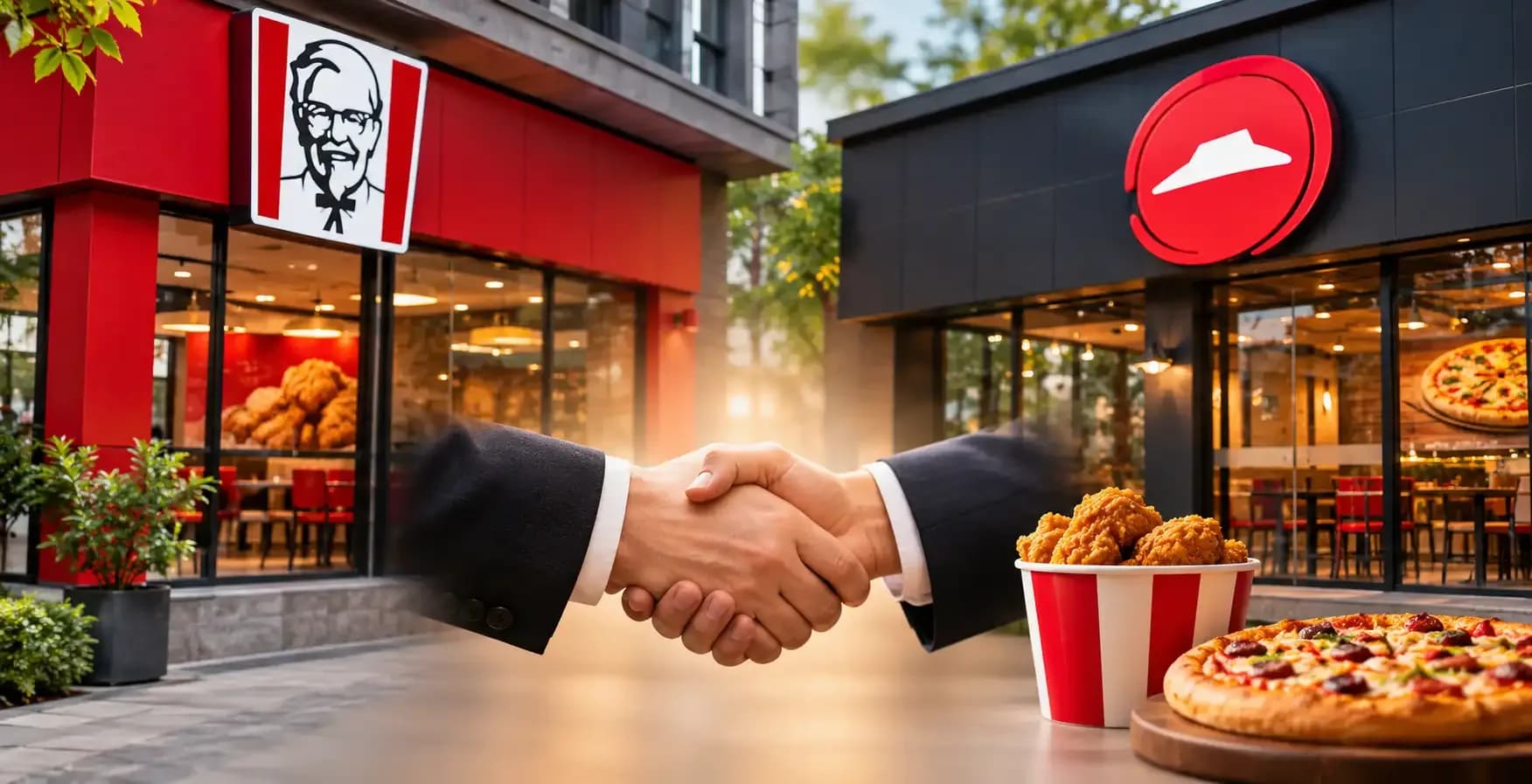
The Competition Commission of India (CCI) has approved the proposed merger of Sapphire Foods India Limited with Devyani International Limited, marking a significant regulatory milestone in the consolidation of India's quick-service restaurant (QSR) industry. The approval, dated October 30, 2026, brings the two major operators of KFC and Pizza Hut in India one step closer to operating under a single corporate platform.
The development is particularly significant because both companies currently operate restaurants under the same global brands but through separate franchise arrangements. The proposed consolidation is designed to bring these operations together under Devyani International, a move expected to streamline decision-making, strengthen supply-chain capabilities and improve operational efficiencies across the combined business.
The CCI announced its decision on October 30, with the Ministry of Information and Broadcasting's Press Information Bureau publishing the confirmation on October 31.
A major consolidation in India's QSR industry
Devyani International, part of the RJ Corp Group, and Sapphire Foods India are two of the principal franchise operators of Yum! Brands in the Indian market.
Devyani operates KFC and Pizza Hut restaurants across India, alongside Costa Coffee, New York Fries, Sanook Kitchen and its own homegrown food brands. Sapphire Foods also operates KFC and Pizza Hut outlets in India, in addition to Pizza Hut and Taco Bell operations in Sri Lanka.
Under the proposed arrangement, Sapphire Foods will merge into Devyani International through a share-swap mechanism. The transaction will consolidate the Indian franchise operations of KFC and Pizza Hut under one listed company, subject to completion of the remaining regulatory and legal formalities.
Importantly, the transaction does not involve a merger of the KFC and Pizza Hut brands themselves. Both will continue to operate as separate consumer-facing brands under Yum! Brands' franchise framework.
Understanding the merger structure
The companies announced the merger on January 1, 2026, with their respective boards approving the scheme of arrangement.
Under the agreed share-swap ratio, Devyani International will issue 177 equity shares for every 100 shares held by Sapphire Foods shareholders.
The transaction also includes separate commercial arrangements with Yum! Brands. These include a payment of ₹320 crore towards merger approval and additional territory rights, as well as the acquisition of 19 KFC restaurants in Hyderabad from Yum India's operating entity for ₹90 crore.
The merger is therefore more than a straightforward amalgamation of two restaurant operators. It also involves the consolidation of franchise rights and the transfer of specific restaurant operations to create a unified operating structure.
Why the CCI approval matters
The CCI's assessment focused on whether combining the two restaurant operators could adversely affect competition in India's food-services market.
The regulator considered multiple possible market definitions, including the broader food-services market, organised food services and the quick-service restaurant segment, with both organised and unorganised operators.
The assessment also considered the pan-India geographic market.
In its order, the Commission concluded that the proposed combination did not raise competition concerns in any of the plausible relevant markets examined. Consequently, it considered it unnecessary to conclusively determine the precise boundaries of the relevant market.
The CCI also examined a limited vertical linkage involving Varun Beverages Limited, another RJ Corp Group company, which supplies beverages, primarily soft drinks, that are sold alongside food products at the restaurants.
The approval removes a significant competition-regulatory hurdle for the transaction. However, it should not be interpreted as the final legal completion of the merger.
The financial case: Can scale translate into profitability?
One of the biggest reasons behind the proposed consolidation is the opportunity to improve the economics of operating a large restaurant network.
The companies have indicated that the combined platform could generate annual synergies of approximately ₹210 crore to ₹225 crore from the second full year of integrated operations.
These expected benefits are linked to several areas:
Consolidation of overlapping corporate and administrative functions.
Improved procurement through larger purchasing volumes.
Better supply-chain and distribution efficiencies.
Shared technology and operational infrastructure.
Stronger negotiations with vendors and commercial partners.
Greater coordination in marketing, promotions and restaurant expansion.
However, the potential financial benefits should be viewed against the operating challenges facing the QSR industry.
Restaurant operators continue to navigate elevated operating costs, competitive pricing, changing consumer spending patterns and pressure on restaurant-level margins. The merger's success will therefore depend not simply on the size of the combined network, but on whether the company can translate that scale into sustainable improvements in profitability.
The projected synergies are management estimates and will depend on successful integration and execution.
Pizza Hut revival and KFC expansion emerge as strategic priorities
The merger also provides an opportunity to address the different operating requirements of the two brands.
For KFC, the consolidated platform is expected to support expansion through a broader operating footprint, improved procurement and more coordinated franchise management.
Pizza Hut presents a different strategic challenge. The brand operates in a highly competitive pizza market, where it faces established organised competitors as well as regional and independent players.
The companies have identified strengthening and revitalising Pizza Hut as an important objective of the merger.
A unified operating structure could help improve decision-making around restaurant locations, product innovation, promotions and cost management. However, improvements in customer demand and restaurant-level performance will remain essential to the brand's long-term growth.
What it means for India's restaurant industry
The proposed merger reflects a broader consolidation trend in India's organised food-services sector, where scale, supply-chain efficiency and disciplined expansion are becoming increasingly important.
A unified Yum! franchise operating platform could create a stronger negotiating position with suppliers, logistics partners, landlords and other service providers.
It could also change the competitive dynamics for other organised restaurant operators, including Jubilant FoodWorks, which operates Domino's in India, and Westlife Foodworld, which operates McDonald's restaurants in West and South India.
However, the impact on competition will not be determined by store count alone. Consumer preferences, pricing, menu innovation, delivery capabilities and restaurant-level economics will continue to influence market performance.
For suppliers and food-service partners, the consolidation could also create opportunities to work with a larger operating network. At the same time, a more centralised procurement structure could change existing vendor relationships and commercial negotiations.
Although CCI approval represents an important milestone, the merger must still complete the remaining statutory and regulatory processes.
These include the applicable National Company Law Tribunal (NCLT) proceedings, shareholder and creditor approvals as required under the scheme, and other necessary formalities before the arrangement becomes effective.
Until the merger becomes legally effective, Devyani International and Sapphire Foods will continue to remain separate listed companies.
The January 2026 merger announcement had indicated an estimated approval timeline of 12 to 15 months. The latest CCI clearance brings the transaction further along that process, although the final completion date will depend on the remaining proceedings.
The Devyani-Sapphire Foods merger is an important development in the evolution of India's organised QSR market. It brings two major franchise operators together in a proposed structure that could improve operating efficiency, strengthen franchise management and provide a larger platform for future expansion.
But the real test will begin after the merger becomes effective.
With projected annual synergies of ₹210 crore to ₹225 crore, the combined business has a measurable efficiency opportunity. Whether that translates into stronger margins, improved restaurant performance and sustainable growth will depend on execution, particularly in the case of Pizza Hut.
For India's food-services industry, the transaction is a reminder that the next phase of QSR growth may be shaped as much by operational efficiency and profitability as by the number of new restaurants opened.