
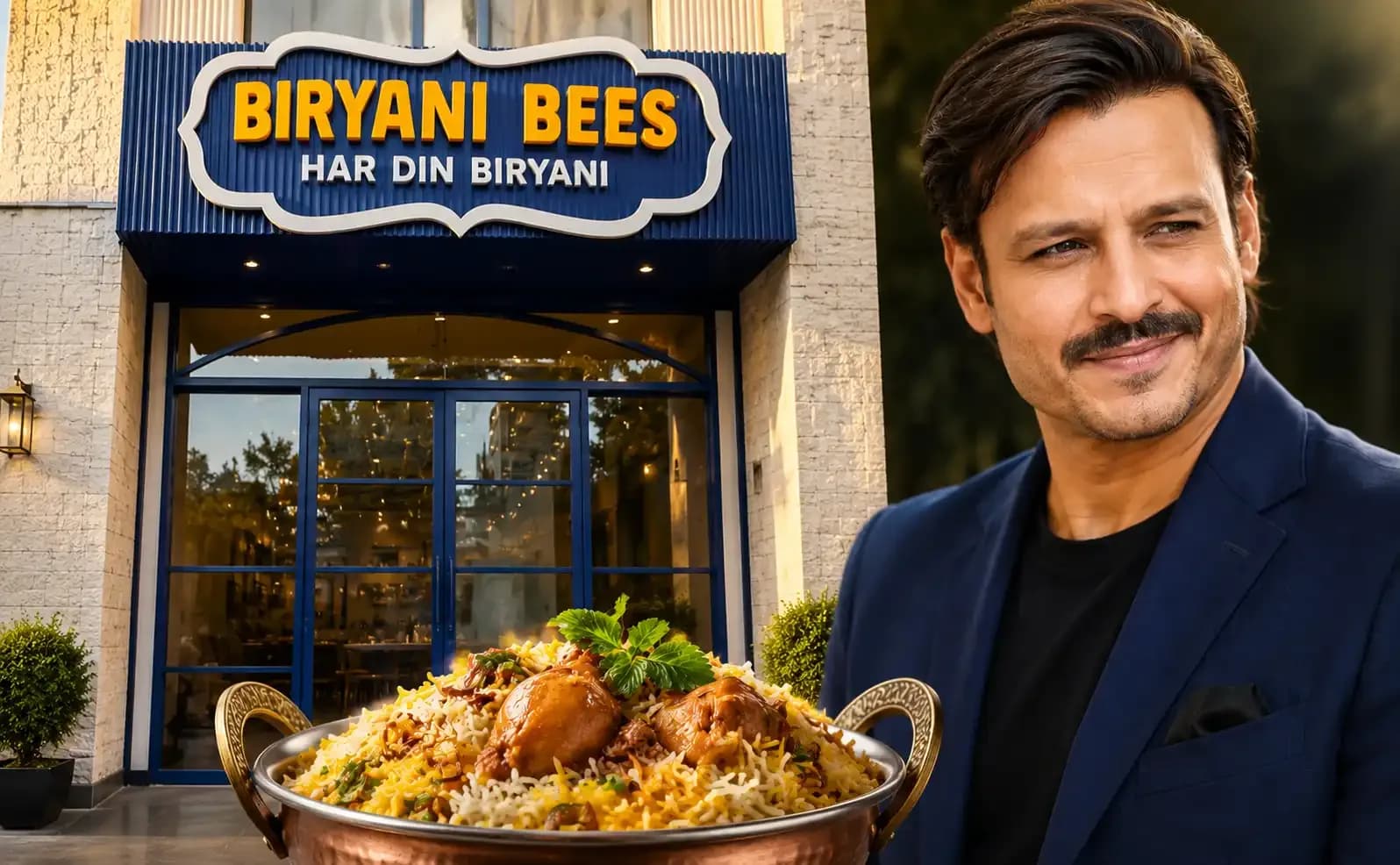
Biryani and Indian meals brand Biryani Bees has raised $1 million from the Vivek Oberoi Family Office, as the food startup prepares to accelerate its expansion beyond its existing footprint in Uttar Pradesh and build a larger presence across India's Tier-II markets.
The funding was announced on August 27, 2026, with the company planning to use the fresh capital to expand from its current three outlets to 10 outlets across Uttar Pradesh, Madhya Pradesh and other high-potential Tier-II markets.
The investment comes at a time when India's organised food-service market is seeing increasing interest in regional brands that can build standardised operations and expand beyond major metropolitan markets.
Biryani Bees targets 10 outlets with fresh capital
Founded by Nitin Tiwari and incubated by Wolfpack Labs, Biryani Bees currently operates three outlets in Uttar Pradesh. The company plans to use the investment not only for opening new restaurants but also for building the operational infrastructure required to support expansion across multiple states.
A significant portion of the capital will go towards strengthening the company's central kitchen infrastructure, expanding its operations team and developing a repeatable expansion playbook for new markets.
The company operates through a central-kitchen-led model, which it says allows it to maintain consistency in food quality, preparation and pricing while scaling its outlet network.
Biryani Bees currently reports an annual revenue run rate of approximately ₹25 crore and says that it is profitable. These figures are company-reported and have not been independently verified.
Vivek Oberoi backs the business model
For actor and investor Vivek Oberoi, the investment opportunity extends beyond the popularity of biryani itself.
Oberoi said the family office was attracted to the business model and its potential to serve India's growing Tier-II and Tier-III consumer markets with standardised and affordable food offerings.
The investor has also drawn a comparison between Biryani Bees' ambitions and the evolution of global QSR chains, with the company aiming to build what it describes as the “McDonald's of Biryani” — a consistent, accessible and trusted everyday food brand.
Central kitchens at the heart of expansion strategy
Biryani Bees' central-kitchen model is expected to play a crucial role as the company enters new cities.
Rather than relying entirely on independent kitchens at every outlet, the model is designed to centralise food preparation and standardise processes. The company believes this can help maintain consistency while improving the economics of operating multiple outlets.
The approach will now be tested outside the brand's existing markets as it expands into Madhya Pradesh and other Tier-II locations.
Larger institutional round planned
The latest $1 million investment is being positioned as an initial scale-up phase rather than the company's final institutional funding round.
Biryani Bees intends to first expand to 10 outlets and demonstrate that its operating model can be replicated across multiple states. Once that model has been established, the company expects to pursue a larger institutional funding round to support national expansion.
This makes the next phase particularly important for the company. Its ability to maintain food quality, pricing, customer demand and outlet-level economics while entering unfamiliar markets will determine how successfully it can transition from a regional restaurant brand into a national QSR business.
Building a national biryani brand
Biryani Bees has also established a presence on food-delivery platforms including Zomato and Swiggy, and the company claims to have a strong position in the biryani category in the cities where it currently operates.
The company's broader ambition is to build a standardised Indian food brand focused on everyday consumption rather than positioning itself solely as a premium or destination restaurant.
With the backing of the Vivek Oberoi Family Office, the immediate challenge is clear: take a three-outlet business to 10 outlets, prove that the model works across markets and then use that track record to attract larger institutional capital.
For Biryani Bees, the $1 million investment therefore represents more than expansion capital. It is a test of whether a regional biryani concept can build the operational consistency and scale required to compete as a national Indian QSR brand.