

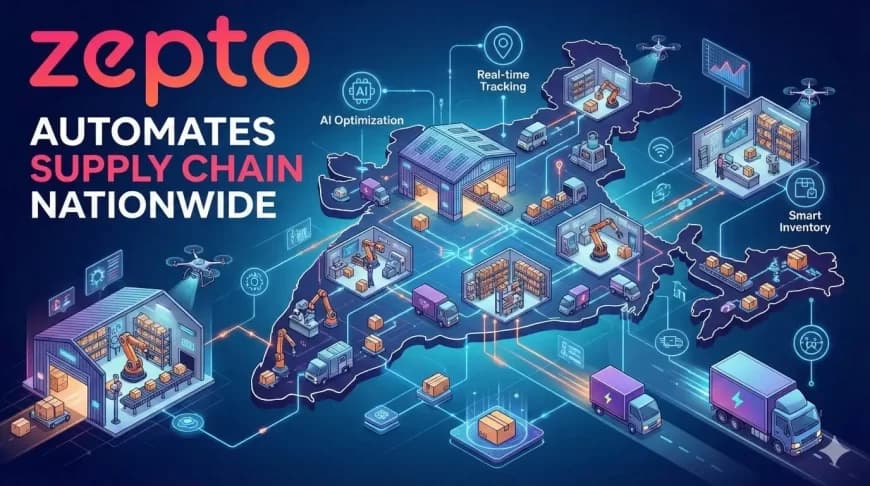
Quick commerce platform Zepto has fully automated its backend supply chain operations across India, marking a major milestone in its technology-driven growth strategy. Announced by CEO Aadit Palicha through a LinkedIn post on Wednesday, the company now manages nearly 25 lakh FMCG units per day using automated workflows across its nationwide network.
According to Palicha, the upgrade is already delivering significant efficiency gains, improving productivity and lowering operating costs across Zepto’s expanding warehouse ecosystem.
Automation Boosts Productivity and Reduces Costs
Sharing a behind-the-scenes video from one of Zepto’s warehouses, Palicha highlighted that automation has improved outbound manpower productivity by over 45% compared to manual operations.
He noted that this efficiency surge is expected to generate annual cost savings worth several hundred crores, strengthening Zepto’s unit economics in the highly competitive quick commerce market.
In-House Engineering Powers the Automation Rollout
The CEO also revealed that Zepto’s engineering teams have built proprietary software systems to operate and coordinate automated assets across its supply chain.
These systems integrate directly with Zepto’s logistics infrastructure, enabling seamless movement, tracking, and processing of FMCG inventory.
Automation Arrives Amid Wider Quick Commerce Challenges
The development comes at a time when the quick commerce sector is navigating supply chain stress, staffing shortages, and rising demand for hyperlocal warehousing.
Earlier this year, reports indicated that Zepto Café, the brand’s 10-minute food delivery vertical, scaled down due to sourcing challenges and a shortage of trained kitchen staff.
Meanwhile, India’s booming quick commerce industry has intensified demand for dark stores and micro-warehouses, with requirements now estimated to be three times higher than available supply.
Small-format warehouse spaces ranging from 2,000 to 8,000 sq ft, often converted from underutilised properties in residential neighbourhoods, are becoming the backbone of fast delivery networks.
What This Means for Zepto and Quick Commerce in India
Zepto’s nationwide automation push positions the company to handle higher order volumes efficiently while reducing dependence on manual labour. With quick commerce competition heating up, automation-led cost optimisation could become a key differentiator.
FAQ
1. What has Zepto announced about its supply chain?
Zepto confirmed that it has automated its supply chain operations across India, now processing around 25 lakh FMCG units daily through automated systems.
2. How much has automation improved Zepto’s productivity?
The company reports a 45% improvement in outbound manpower productivity compared to traditional manual operations.
3. What technology powers Zepto’s automated network?
Zepto’s engineering team has built in-house proprietary software that controls automated warehouse assets and integrates them with its logistics infrastructure.
4. Why is automation important for quick commerce companies?
Automation helps reduce errors, boost speed, cut labour dependency, and lower operating costs—crucial advantages in the highly competitive 10–30-minute delivery market.
5. What challenges is the quick commerce sector facing?
The industry is dealing with supply chain constraints, workforce shortages, and a huge gap in hyperlocal warehouse availability, which is driving demand for small-format dark stores.