
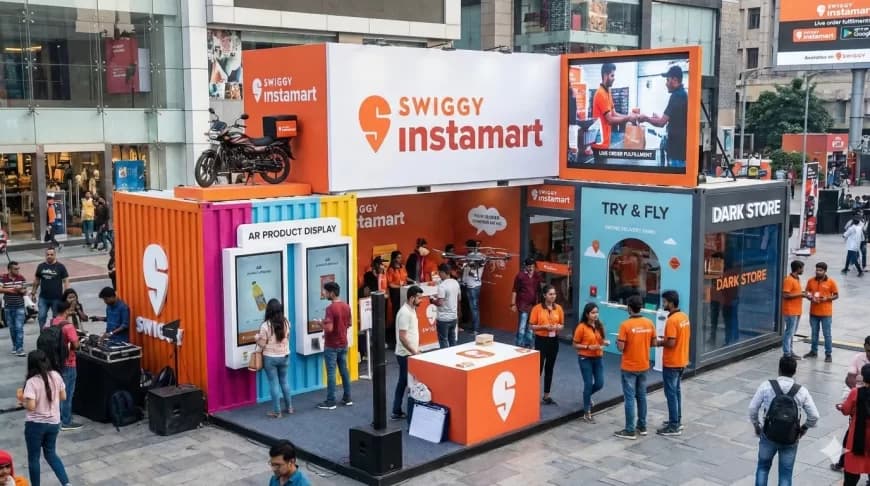
Swiggy’s quick commerce arm, Instamart, has taken a new step by opening its first offline experiential store in Gurugram. The pilot store allows customers to physically explore select products even as instant delivery remains the core business. The move reflects how India’s quick commerce sector is evolving beyond pure speed-led convenience.
Instamart’s First Offline Experience Store: What’s New
Instamart has launched a compact, Instamart-branded experiential store designed to complement its online-first model. Unlike traditional retail outlets, the store focuses on discovery rather than large-scale sales.
Located in Gurugram, the mini-format store gives consumers a “touch and feel” experience for products that are otherwise ordered digitally on the platform.
How the Offline Instamart Model Works
These experiential stores are expected to operate in and around residential societies and will be run by sellers, similar to Instamart’s existing dark store partners.
Key operational differences
Seller-led sales: Revenue from offline purchases goes directly to sellers
Different from online flow: Unlike the app-based model, payments are not routed through Swiggy first
Experience-driven: The store is meant for product discovery, not bulk buying
Importantly, these outlets are not conventional retail stores but curated experience zones.
Store Size and Product Range
The Instamart experiential store follows a significantly smaller footprint compared to dark stores.
Store format highlights
Size: Around 400 sq ft
SKU count: Roughly 100–200 products
Dark store comparison: 15,000–20,000 SKUs across ~4,000 sq ft
This sharp contrast underlines the experimental and exploratory nature of the concept.
Product Categories Available
The offline experience store focuses on categories where physical inspection can influence buying decisions.
Key categories include
Fresh fruits and vegetables (F&V)
Pulses and daily essentials
New product launches
Select D2C (direct-to-consumer) brands
These categories align with consumer demand for quality checks and first-hand evaluation.
Is Instamart Moving Toward Offline or Omnichannel Retail?
For now, the answer appears to be no. According to people familiar with the matter, this pilot does not signal a shift to an omnichannel retail strategy.
Swiggy has not disclosed whether the Gurugram store will be scaled or replicated in other cities. The company also did not respond to media queries regarding long-term plans for offline expansion.
Strategic Context: QIP Fundraise and Quick Commerce Push
The experiment comes shortly after Swiggy raised ₹10,000 crore through a Qualified Institutional Placement (QIP). The company has stated that nearly 50% of the proceeds will be used to strengthen its quick commerce operations, including infrastructure and expansion.
This suggests that experiential formats could play a supporting role as competition in quick commerce intensifies.
What This Means for Quick Commerce in India
Instamart’s offline experiential store reflects a broader shift in quick commerce—from pure speed to consumer engagement and product discovery. While still early and limited in scope, the experiment highlights how platforms are testing hybrid touchpoints without abandoning their digital-first DNA. Whether this model scales or remains a niche pilot will be closely watched by the retail and FMCG ecosystem.
FAQs
1. What is Swiggy Instamart’s experiential store?
It is a small, offline discovery-focused store where customers can physically see and feel select products sold on the Instamart platform.
2. Where is the first Instamart offline store located?
The pilot experiential store has been launched in Gurugram.
3. Is Instamart entering offline retail?
No. The store is an experimental format and does not indicate a full-scale move into offline or omnichannel retail.
4. How is this store different from a dark store?
Dark stores are large fulfilment centers with thousands of SKUs, while experiential stores are smaller, seller-run spaces with limited product ranges.
5. How does this relate to Swiggy’s recent QIP fundraise?
Swiggy plans to use a significant portion of its ₹10,000 crore QIP proceeds to expand quick commerce, under which such experiments may fall.